

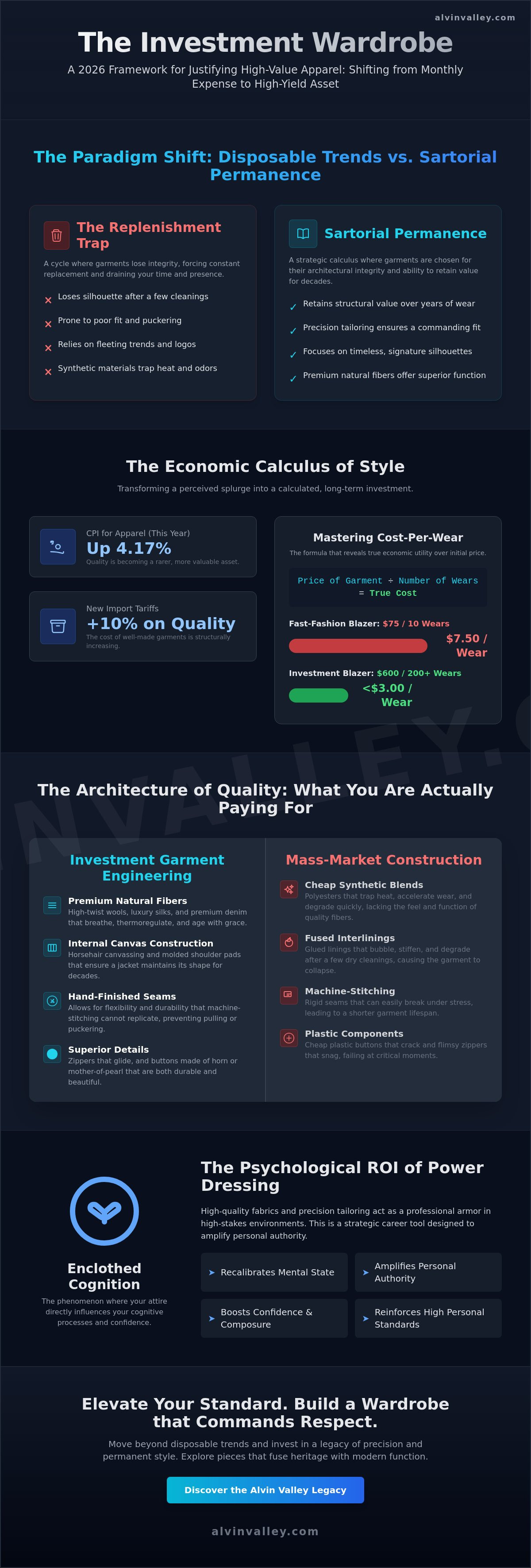
What if your wardrobe was a high-yield asset rather than a monthly expense? Most women have felt the frustration of a fast-fashion blazer losing its silhouette after two cleanings or the quiet sting of a poor fit during a high-stakes presentation. You understand that disposable clothing is a drain on your time and your presence. Learning how to justify buying expensive clothes requires a shift from emotional spending to a technical, strategic calculus. It's about moving beyond the label to recognize the architectural integrity of a garment.
This article provides a definitive framework for 2026. We will transform luxury purchases from a perceived splurge into a calculated move for your professional legacy. You'll discover the sartorial logic that justifies a higher price point, especially as the CPI for apparel has risen 4.17% this year. We'll explore the economic reality of cost-per-wear, the impact of new 10% import tariffs on quality, and the technical markers that separate a temporary trend from a permanent staple. From the precision of a Doyenne Indigo Wash Jean to the timeless drape of a Ballet Knit Top, you'll learn to build a wardrobe that commands respect and lasts for decades.
Key Takeaways
- Shift your perspective from disposable trends to sartorial permanence. Learn to identify garments that retain structural value over years of wear.
- Master the Cost-Per-Wear formula. This calculation reveals how to justify buying expensive clothes through long-term economic utility rather than initial price.
- Recognize the technical markers of excellence. Understand why natural fiber density and internal tailoring architecture are non-negotiable for garment longevity.
- Apply the Seam Stress Test. Ensure your investment pieces maintain their silhouette and integrity under the demands of a high-powered lifestyle.
- Connect with a legacy of precision. Learn why pieces like the Alvin Valley Doyenne Jean represent the ultimate fusion of heritage and modern function.
The Paradigm Shift: From Disposable Trends to Sartorial Permanence
The era of the disposable haul is ending. In its place, a more rigorous standard has emerged for the modern woman who values her time and her presence. Knowing how to justify buying expensive clothes starts with recognizing that price is often a proxy for longevity. Fast fashion relies on a replenishment trap. It's a cycle where garments lose their integrity after minimal wear, forcing you into a constant state of replacement. This is the antithesis of the Slow Fashion Movement, which prioritizes the structural and aesthetic endurance of a piece over fleeting novelty. Choosing quality is a rejection of the temporary.
In 2026, the most expensive garments rarely announce themselves with loud logos. True luxury is whispered; it's felt in the weight of the silk and the precision of the stitch. While fast fashion attempts to turn the wearer into a walking billboard, investment dressing focuses on the signature silhouette. You aren't paying for a name. You are paying for the absence of compromise in the manufacturing process. When you understand how to justify buying expensive clothes, you stop looking for a label and start looking for the architectural integrity of the garment itself.
The True Definition of Luxury in 2026
Luxury is substance. It's a relative term that becomes clear only when measured against a timeline of decades rather than weeks. To evaluate a garment, you must look past the marketing and into the technical precision of the fiber. It's the shift from chasing a trend to owning a piece that remains relevant as seasons fade. High-value apparel retains its shape, its color, and its dignity long after cheaper alternatives have been discarded. It's an ownership of form that transcends the calendar.
The Psychological ROI of Power Dressing
What you wear dictates how you think. Psychologists refer to this as enclothed cognition, the phenomenon where the quality of your attire directly influences your cognitive processes and confidence. Wearing an authoritative blazer doesn't just change how others see you; it recalibrates your own mental state. High-quality fabrics and precision tailoring act as a professional armor in high-stakes environments. This sense of composure is a tangible asset in negotiations and leadership. Investment dressing is a strategic career tool designed to amplify personal authority through the medium of permanent style.
The Architecture of Quality: What You Are Actually Paying For
The price of a garment is often an indicator of its internal engineering. When you look at a luxury piece, you are paying for the invisible. High-end construction relies on internal structures like horsehair canvassing and precisely molded shoulder pads. These elements ensure a jacket maintains its shape for decades. Mass-market alternatives rely on fused interlinings. These glues eventually bubble and degrade after a few dry cleanings. Understanding this technical gap is key to learning how to justify buying expensive clothes. It's the difference between a garment that collapses and one that commands the room.
Precision extends to the smallest details. Zippers should glide without resistance. Buttons should be made of horn or mother-of-pearl, never plastic. Hand-finished seams allow for a degree of flexibility that machine-stitching cannot replicate. These markers of quality aren't just for show. They prevent the garment from pulling or puckering over time. You are investing in the assurance that your wardrobe won't fail you at a critical moment. For a masterclass in this standard, explore the technical specifications of Alvin Valley designer pants.
Fabric as a Foundation
Premium materials are the bedrock of any investment piece. High-twist wools, premium denim, and luxury silks offer more than just a superior hand-feel. They provide essential thermoregulation and breathability that synthetic blends lack. Cheap polyesters trap heat and odors, which accelerates the wear cycle. High-quality textiles age with a specific grace. These materials don't just survive the years; they evolve with the wearer. The Psychology of Fashion suggests that the tactile quality of our clothing deeply influences our cognitive performance. High-quality fibers reinforce a sense of personal discipline and high standards.
Fit vs. Silhouette: The Designer Difference
A perfect fit is a feat of complex pattern-making. Mass-market patterns are graded for a generic average. This often results in a fit that is technically correct but aesthetically poor. Designer patterns are engineered for the three-dimensional movement of the modern woman. This is the 'King of Pants' standard. It involves calculating the exact tension required to create a lifting trouser or a slimming blazer. High-end fabrics possess a unique structural memory that allows them to snap back to their original silhouette even after a day of high-stakes meetings. This technical superiority is exactly how to justify buying expensive clothes. It ensures that your presence is defined by precision rather than compromise.
The Calculus of Style: Analyzing Cost-Per-Wear
True luxury is a mathematical certainty. To understand how to justify buying expensive clothes, you must look past the initial transaction. The Cost-Per-Wear (CPW) formula is the only metric that matters: Price divided by the number of times worn equals the true value. A high sticker price is often a shield against the recurring cost of replacement. This mathematical shift is the most effective way to understand how to justify buying expensive clothes in an era of rising apparel costs. Precision pays. Quality endures.
When calculating the true cost-per-wear, the hidden economics of your closet become clear. A cheap garment is often the most expensive thing you own because its utility is finite. Luxury items are designed for a decade of service. They are engineered to be repaired rather than replaced. This durability creates a maintenance dividend. High-quality wool and premium cotton require less frequent cleaning and retain their aesthetic integrity far longer than synthetic alternatives. You aren't just buying a look. You're buying time.
The 3-Year Wardrobe Comparison
Consider the lifecycle of denim. A mass-market pair often loses its recovery and color within months. By year three, you've likely paid a replacement tax multiple times over. Contrast this with luxury wide-leg jeans engineered for structural permanence. These pieces maintain their silhouette through hundreds of wear cycles. When you factor in the total cost of ownership including repairs, the investment piece consistently outperforms the disposable alternative. It's a matter of fiscal discipline disguised as fashion.
Resale and Circular Fashion
Luxury is liquidity. In 2026, the global thrifted fashion market is projected to be worth $222 billion. High-end designer items are not sunk costs; they are stored value assets. Brands with a heritage of craftsmanship retain significant value on secondary markets like eBay or specialized luxury resale platforms. A masterfully constructed garment functions as a blue-chip stock for your wardrobe, yielding dividends in both personal authority and capital retention. You're building a portfolio of style that can be liquidated or passed down. This is the ultimate justification for the discerning buyer.
The Investment Checklist: 5 Rules for Discerning Buyers
Precision is a choice. As clothing prices rise above the general rate of inflation, knowing how to justify buying expensive clothes becomes a vital skill for the modern executive. You need a structured methodology. Don't rely on the price tag alone. Use this five-point checklist to verify the substance of your next acquisition.
- Rule 1: The Seam Stress Test. Inspect the stitch count. High-end garments feature a high density of stitches per inch. Seams should be straight, tensioned, and free of loose threads.
- Rule 2: Silhouette Integrity. A garment must hold its shape on the hanger. If the fabric sags or the shoulders collapse without a body inside, the internal architecture is lacking.
- Rule 3: Versatility Quotient. Apply the rule of three. Can you style this piece in three distinct contexts? If it only works for one event, it isn't an investment; it's a costume.
- Rule 4: Fabric Origin. Identify the mill. Heritage materials from reputable sources indicate a commitment to quality that transcends seasonal trends.
- Rule 5: The Confidence Check. Pay attention to your posture. A masterfully tailored piece should naturally align your frame and elevate your presence.
Evaluating the Construction in the Fitting Room
Don't be deceived by vanity sizing. True luxury follows an architectural fit rather than a flattering number. Look at the lining of high-end blazers and coats. It should be made of breathable natural fibers like silk or cupro, never cheap polyester. Check the pattern matching at the seams. If a pinstripe or check doesn't align perfectly across a seam, the manufacturer has cut corners to save on fabric costs. These details are the hallmarks of technical superiority.
The Versatility Test
Foundational pieces deserve the largest share of your budget. Focus your capital on trousers and blazers. These items provide the highest ROI because they bridge the gap between professional authority and social grace. A day-to-night transition is the ultimate metric for utility. Avoid trend traps that prioritize novelty over longevity. Instead, seek out timeless icons that will remain relevant in your 2030 wardrobe. This long-term thinking is exactly how to justify buying expensive clothes in a volatile market.
Invest in a silhouette that commands the room. Secure your wardrobe foundation with the Doyenne Jean and experience the permanence of heritage tailoring.
Elevating the Standard: The Alvin Valley Legacy
Precision is not a luxury. It is a prerequisite for a powerful life. At Alvin Valley, the philosophy is simple: we create garments that act as a permanent foundation for your personal authority. This commitment to excellence provides the ultimate answer to how to justify buying expensive clothes. When you invest in our collection, you're not paying for a marketing campaign or a retail markup. You're paying for a storied metropolitan fashion heritage compressed into a single, perfect seam. Our direct-to-consumer model ensures that every dollar is funneled back into the quality of the garment rather than traditional overhead.
Our Doyenne Jean represents the pinnacle of this approach. It is the ultimate justification of luxury denim. While the broader industry often prioritizes high-volume production, we maintain a focus on technical superiority. An Alvin Valley piece is designed to be a cornerstone of your wardrobe; it retains its structural integrity through years of high-stakes environments. You're not just buying denim. You're acquiring a piece of engineering that respects your form and your time. It is a legacy you wear every day.
The King of Pants: A Study in Fit
The title 'King of Pants' was earned through a relentless focus on the female silhouette. Historically, the perfect pant has been the most difficult garment to master. It requires a marriage of urban fashion history and functional, modern utility. Our designs don't just cover the body; they engineer a presence. This focus on silhouette transcends seasonal trends and fleeting aesthetics. We believe that empowerment begins with a fit that never falters. It's a standard that transforms a simple trouser into a professional asset that commands the room.
Your Next Move in Style
Building an investment wardrobe doesn't require an immediate overhaul. It begins with a single, perfect piece that changes how you move through the world. Understanding how to justify buying expensive clothes is the first step toward a more intentional, high-status lifestyle. We invite you to explore our foundational collection and discover the difference that precision makes. Your wardrobe should be as ambitious as your career goals. Experience the precision of the Doyenne Collection today and secure your sartorial future.
Mastering the Art of the Permanent Wardrobe
Choosing quality is a declaration of intent. You now possess the analytical framework to distinguish between a fleeting expense and a strategic asset. Understanding how to justify buying expensive clothes involves shifting your focus from the initial price tag to the enduring cost-per-wear and the structural integrity of the garment. It's about recognizing that technical excellence is the only true path to sartorial permanence.
True luxury doesn't shout; it supports. This standard is defined by a heritage fit perfected over decades and premium fabrics sourced from the world's finest mills. By opting for direct-to-consumer luxury without the traditional markup, you ensure that every stitch serves your professional legacy. You aren't just buying clothing. You're curating a collection that commands respect and reflects your highest standards. Your wardrobe should be as resilient and ambitious as the life you've built.
Build your legacy wardrobe with the King of Pants.
Your presence is your most valuable asset. Invest in it with the precision it deserves and the confidence it provides.
Frequently Asked Questions
Is it better to buy one expensive item or multiple cheaper ones?
One expensive item is almost always superior for long-term value. Multiple cheaper items create a replenishment trap where frequent replacement costs eventually exceed the price of a single, durable piece. A high-quality garment maintains its silhouette and structural integrity through years of use. This is the core of how to justify buying expensive clothes. You are trading volume for technical permanence and a more authoritative presence.
How can I tell if an expensive brand is actually high quality?
Inspect the internal architecture and finishings rather than the marketing. High-quality brands use natural fibers with high density and feature clean, hand-finished seams. Look for horn or mother-of-pearl buttons and smooth-gliding zippers. If a brand relies on prominent logos but has fused interlinings or synthetic linings, it's prioritizing status over substance. Precision tailoring remains the hallmark of true luxury.
Which clothing items are most worth investing in?
Foundational pieces that bridge professional and social contexts offer the highest return on investment. Trousers, blazers, and coats are the essential pillars of a powerful wardrobe. Items like a masterfully tailored wide-leg jean or a structured blazer provide the most utility because they define the silhouette. These pieces endure through changing trends and maintain their presence in high-stakes environments for decades.
Does 'expensive' always mean 'sustainable'?
Not necessarily, though the two often align through longevity. True sustainability in 2026 is found in the Slow Fashion Movement, which emphasizes durability and repairability. While some expensive brands still use high-impact processes, the inherent longevity of a well-made garment reduces the environmental cost of constant replacement. You must verify the fabric origin and production standards to ensure the brand meets your ethical criteria.
How do I calculate the cost-per-wear of a designer item?
Divide the purchase price by the projected number of times you will wear the garment over its lifetime. A garment worn twice a week for five years has a significantly lower true cost than a cheap item worn three times before it loses its shape. This mathematical clarity is exactly how to justify buying expensive clothes. It transforms a perceived splurge into a calculated move for personal capital retention.
What are the signs of poor quality in high-priced clothing?
Look for uneven stitching, puckered seams, and the use of synthetic linings like polyester. If pinstripes or checks don't align at the seams, the construction was rushed to save on fabric costs. Poor quality often hides in the invisible parts, such as glued interlinings that will bubble after dry cleaning. A high price tag should never excuse a lack of technical precision or material substance.
How should I care for expensive clothes to ensure they last?
Minimal intervention is the key to preserving luxury fibers. Use cedar hangers to maintain shoulder structure and steam instead of ironing to avoid fiber damage. High-quality wool and silk require less frequent cleaning than synthetics because they are naturally breathable and odor-resistant. When cleaning is necessary, utilize a specialist who understands the demands of delicate internal architectures and heritage materials to ensure the garment survives.
Can expensive clothes actually help my career?
Yes, through the psychological effect of enclothed cognition and the projection of personal authority. High-quality tailoring alters your posture and mindset, which directly influences your performance in negotiations and leadership. A wardrobe that commands respect acts as professional armor. It signals a commitment to excellence and an attention to detail that colleagues and clients recognize as a marker of a high-status lifestyle.