
The most powerful color in your wardrobe isn't black. It's red. Specifically, a perfectly constructed red blazer that fits with the kind of architectural precision that makes a room go quiet when you walk in.
You already know that fit is everything. You've experienced the frustration of a jacket that sits too stiff across the shoulders, too boxy through the waist, too corporate in its ambition and too timid in its result. And if red has ever felt like a risk, like a color that shouts rather than commands, that instinct is worth examining. Because the problem was never the color. It was the cut.
This guide exists to change how you think about red entirely. Drawing on the precision-fit heritage that defines Alvin Valley's approach to tailoring, we'll walk you through the technical markers of a truly exceptional blazer, show you how to read quality in construction and silhouette, and demonstrate how red, styled correctly, functions as a sophisticated neutral within a luxury wardrobe. By the end, you won't be asking whether you can wear red. You'll be asking why you waited this long.
Key Takeaways
- A perfectly tailored red blazer is not a statement piece — it is a power tool, and understanding the psychology behind the color reveals why it commands authority in any room.
- Construction quality separates a luxury red blazer from the rest: learn the critical difference between canvassing and fusing, and why it determines how your garment holds its shape over time.
- Shade selection is a science — discover how to match your undertone to the right red, from cool blue-based crimsons to warm orange-based vermillions, for a result that looks intentional rather than accidental.
- Proportion and torso ratio are the hidden variables in blazer fit; knowing how to read them transforms a good purchase into an architectural investment.
- Alvin Valley's heritage of precision tailoring — built on the 'King of Pants' legacy — brings a structurally superior approach to the women's blazer that prioritizes fit as the ultimate luxury.
The Red Blazer: A Statement of Sophisticated Authority
Some garments occupy a wardrobe. Others own it. A red blazer, cut with architectural intention and worn with the certainty it demands, belongs to the second category entirely. It isn't a seasonal experiment. It isn't a risk. It is a foundational power piece, as essential to the modern woman's wardrobe as a well-structured trouser or a precisely fitted white shirt.
The distinction matters. A foundation piece doesn't ask for permission. It doesn't wait for a trend cycle to validate it. It simply works, season after season, across every register of a high-functioning life.
The Psychology of Power Dressing
In 2026, power dressing is no longer about armor; it's about precision, the deliberate calibration of appearance to project authority before a single word is spoken.
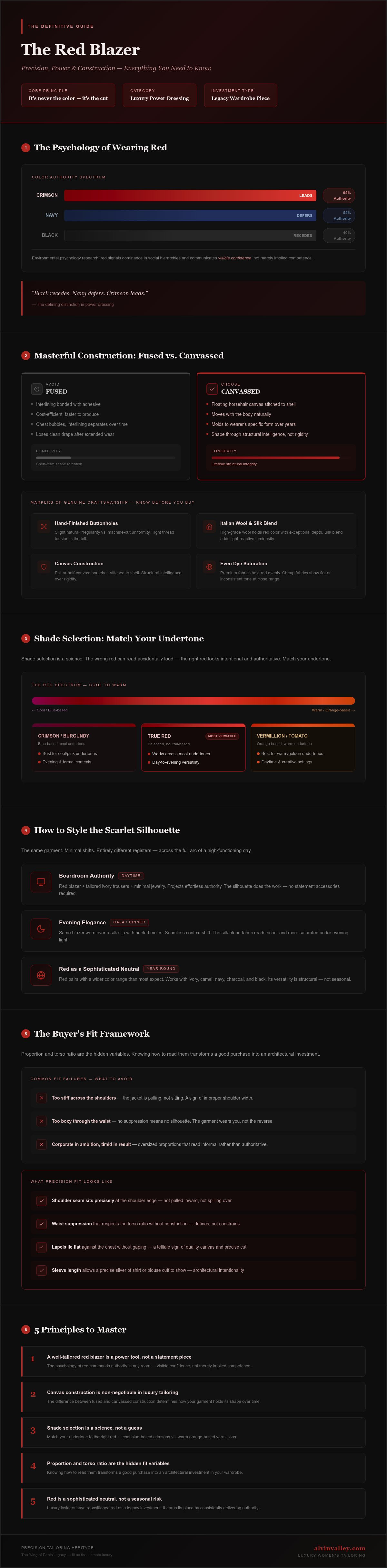
Color is a significant part of that calibration. Research in environmental psychology has long established that red commands attention and signals dominance in social hierarchies. In high-stakes settings, from boardroom negotiations to high-profile public appearances, the choice to wear red communicates something that black and navy simply cannot: visible confidence, not merely implied competence. Black recedes. Navy defers. Crimson leads.
The shift happening in metropolitan fashion circles reflects this understanding. The women who have historically relied on dark, neutral suiting to project authority are increasingly reaching for something more declarative. Not louder. More precise. There's a meaningful difference between a color that shouts and one that commands, and it lives entirely in the quality of the cut.
Red as a Wardrobe Foundation
Trend-driven pieces have a shelf life. A scarlet blazer, constructed with the kind of precision that prioritizes silhouette over novelty, does not. The reason red transcends seasonal fashion is structural: it functions as a sophisticated neutral against a far wider range of colors than most people initially expect.
Consider its range across a single day. Paired with tailored ivory trousers and minimal jewelry, it carries a boardroom with effortless authority. Worn over a silk slip with heeled mules, the same jacket moves seamlessly into an evening context. The garment doesn't change. The sartorial shift is minimal, strategic, and entirely intentional.
This versatility is why luxury fashion insiders have quietly repositioned red as a legacy investment rather than a statement gamble. A red blazer built on precision tailoring, the kind rooted in the architectural fit heritage that defines Alvin Valley's approach, earns its place in a wardrobe not by demanding attention, but by consistently delivering it.
The question was never whether red works. It was always whether the construction could carry it.
Masterful Construction: What Defines a Luxury Red Blazer
Quality in a blazer isn't visible at first glance. It lives inside the garment, in decisions made long before a single seam is pressed. And in a red blazer, where the color amplifies every structural choice, those decisions carry twice the weight.
The single most important distinction in luxury tailoring is the difference between a canvassed and a fused jacket. A fused jacket bonds its internal layers with adhesive. It's efficient, cost-effective, and, over time, it fails. The interlining separates, the chest bubbles, and the jacket loses the clean drape that made it worth wearing. A full or half-canvas construction, by contrast, uses a floating layer of horsehair canvas stitched to the shell fabric. It moves with the body. It molds to the wearer's specific form over years of use. It holds its shape not through rigidity, but through structural intelligence.
Fabric selection compounds this. Italian wool and silk blends are the recognized standard for a reason: the tight weave of a high-grade wool holds color with exceptional depth, which matters enormously in red. Cheaper fabrics absorb dye unevenly, producing a flat or slightly inconsistent tone. A silk blend introduces a subtle luminosity that allows the red to shift under different light conditions, from a composed matte in daylight to something richer and more saturated by evening.
The markers of genuine craftsmanship are specific and, once you know them, impossible to unsee:
- Hand-finished buttonholes: Machine-cut buttonholes have a uniform, slightly rigid appearance. Hand-finished ones show slight irregularity under close inspection, and the thread tension is tighter, more durable.
- Functional sleeve vents: Working buttons on the sleeve cuff are a hallmark of bespoke-adjacent construction. They're unnecessary on a fused, mass-produced jacket because the precision required to set them correctly isn't worth the investment at that price point.
- Pick stitching along the lapel edge: A fine running stitch along the lapel perimeter indicates hand finishing and contributes to the lapel's characteristic roll.
Alvin Valley's 'King of Pants' philosophy translates directly to the blazer through an obsessive focus on the shoulder and waist relationship. The shoulder is the garment's foundation. Set it incorrectly and nothing below it can be corrected. Set it with precision and the entire silhouette follows naturally, creating the kind of clean, authoritative line that reads as effortless from across a room.
Architectural Fit and Silhouette
The shoulder pad in a well-constructed women's blazer isn't about volume. It's about geometry. A precisely calibrated pad extends the shoulder line by just enough to create a clean horizontal plane, which in turn makes the waist suppression below it read as intentional rather than incidental. Waist shaping in a luxury jacket is achieved through side seam tapering and internal boning or stay-stitching, techniques that define the torso without compressing it. When unbuttoned, the jacket should fall in a clean, unbroken line from shoulder to hem, with no pulling at the chest and no flaring at the hip.
The Anatomy of the Lapel
Lapel choice is a structural decision with significant aesthetic consequences. The notch lapel is the standard, versatile and appropriate across most professional contexts. But for a red blazer intended to carry genuine authority, particularly in evening or high-formality settings, the peak lapel is the preferred construction. Its upward-pointing tips extend the visual line of the shoulder, reinforcing the commanding profile the garment is designed to project. The technical execution of a peak lapel is considerably more demanding: the roll must be precisely pressed so the lapel lies flat against the chest without gaping, and the point must be sharp without puckering at the seam. It's a detail that separates a jacket built for performance from one built for appearance alone.
Construction at this level is a long-term investment. Understanding what you're looking for before you buy is how you ensure the garment earns its place in your wardrobe for years, not seasons.
Styling the Scarlet Silhouette: From Boardroom to Gala
A red blazer earns its authority through construction. It earns its versatility through styling. And the women who wear it best understand one foundational principle: restraint is not the enemy of boldness. It's the condition for it.
The most common mistake with a strong color is over-complicating the look around it. Red doesn't need support. It needs precision. Every element you introduce should either ground the jacket or extend its visual logic, nothing more.
The monochromatic approach is the most declarative. Red on red, whether through tonal layering of a deeper burgundy trouser beneath a brighter scarlet blazer, or a precise shade-match for a clean, unbroken column of color, reads as intentional in a way that mixed palettes rarely achieve. It's a look that communicates fluency in color, not desperation for it. Accessories here must be minimal: a single gold cuff, a structured bag in black or cognac leather, nothing that competes.
The high-contrast alternative, a designer blazer against a dark neutral, offers a different register entirely. Crisp white, charcoal, and ivory all work. Each creates a different visual weight beneath the jacket, shifting the overall impression from commanding to composed to quietly assured.
The Power Suit Reimagined
The full suit remains the most architecturally complete expression of the red blazer. Paired with Alvin Valley's precision-tailored trousers, the blazer becomes part of a unified silhouette rather than a standalone statement. Pant selection matters here. A wide-leg cut adds visual weight at the hem, balancing a structured shoulder and creating a clean, column-like proportion. A cigarette cut, by contrast, sharpens the overall line, projecting a more directional, boardroom-ready authority. Neither is wrong. The choice depends entirely on the occasion and the specific geometry of your frame.
Elevated Casual: Blazer and Denim
This is where most styling guides fail. The pairing of a luxury blazer with denim isn't casual dressing. It's controlled contrast, and it requires the same precision as a formal look. Wide leg jeans are the superior partner for a red blazer: the generous hem creates enough visual mass to anchor the jacket's intensity without competing with it. Dark wash is non-negotiable. A mid or light wash reads as unresolved against a saturated red; a deep indigo or near-black denim creates the tonal contrast that makes both pieces read at their best.
Style the blazer over a fine-gauge knit in ivory or camel, left slightly loose at the hem. The effect is deliberately unconstructed below the jacket's precise shoulder line, which is exactly the point. Footwear should ground rather than elevate: a low block heel or a clean leather loafer keeps the proportions honest. Reserve the stiletto for the suit.
- Jewelry: One architectural piece, a sculptural ring or a single-strand chain, over layered delicacy that gets lost against bold color.
- Bags: Structured silhouettes in black, cognac, or nude leather. Avoid pattern. The blazer is already doing the work.
- Footwear: Dark leather loafers or block-heel mules for daywear; a pointed-toe heel in nude or black for evening. Both ground the color without diminishing it.
The rule is simple. Let the jacket lead. Style everything else to follow.
Selecting Your Shade and Fit: A Buyer's Framework
Construction quality gets you into the room. Shade selection determines whether you own it. The single most critical step in luxury color-blocking is matching your red to your undertone, because a shade that fights your complexion doesn't project authority; it creates visual noise.
Finding Your Perfect Red
Undertone is the starting point. Cool undertones, those with pink, blue, or neutral bases in the skin, resolve best against blue-based reds: true crimsons, deep scarlets, and cool-leaning burgundies. These shades sharpen the complexion rather than washing it out. Warm undertones, which carry yellow or golden depth, align with orange-based vermillions and tomato reds. The contrast reads as intentional, alive, and precisely calibrated.
Lifestyle determines depth. A 'power red,' saturated and unapologetically bright, is built for daylight and high-visibility settings: the boardroom, the client presentation, the professional context where presence is the point. An evening burgundy operates in a different register entirely. Its deeper, wine-adjacent tone carries the same authority in lower light without competing with the atmosphere around it. Neither is a compromise. They serve different hours of the same high-functioning life.
The Fit Checklist
Proportion is a variable most buyers underestimate. Blazer length should be calibrated against torso ratio, not height alone. A hip-grazing hem on a shorter torso visually truncates the leg line; a cropped cut, ending at the natural waist, restores it. Taller frames carry a longer jacket with ease, and the extended hem reinforces the commanding vertical line the garment is designed to project.
Sleeve length follows a precise rule: one inch of shirt or blouse cuff should be visible below the jacket sleeve. Not half an inch. Not two. One. That single inch signals tailoring fluency and keeps the proportions clean.
Testing mobility is non-negotiable. Reach forward with both arms. The jacket should move with you without pulling across the upper back or collapsing the shoulder seam. This is the 'hug' test: a well-constructed blazer accommodates the body in motion without surrendering its architectural shape at rest.
Before any purchase, apply three questions. Does the shoulder seam sit precisely at the edge of your shoulder bone, with no overhang and no pulling? Is the chest canvassed rather than fused? And does the garment feel structurally complete at room temperature, before any alterations? A jacket that requires significant tailoring after purchase rarely returns full value on the investment.
Seasonal weight matters too. For 2026, mid-weight Italian wool blends remain the most versatile construction: substantial enough to hold structure in cooler months, breathable enough to carry through transitional seasons without a heavy lining. A half-lined jacket, finished through the body and left open at the back hem, offers superior drape and significantly better temperature regulation than a fully lined alternative.
A red blazer at this level isn't a seasonal purchase. It's a decade-long relationship. Choose accordingly, and explore Alvin Valley's precision-tailored women's blazers to find the construction standard your wardrobe deserves.
The Alvin Valley Red Blazer: Precision in Every Stitch
There are brands that make blazers. And there are brands that understand them. Alvin Valley belongs to the second category, and the distinction is structural, not cosmetic.
The approach here isn't borrowed from a generalist fashion framework. It's drawn from a specific, hard-won mastery of fit, the same obsessive attention to proportion and construction that earned Alvin Valley the title of 'King of Pants.' That legacy doesn't simply inform the blazer. It defines it.
A Legacy of Tailoring
Precision in trouser construction and precision in blazer construction share the same foundational logic: the garment must work with the body's geometry, not against it. Alvin Valley's heritage in pant design built an architectural vocabulary centered on torso ratio, waist definition, and the relationship between vertical line and visual authority. Applied to the blazer, that vocabulary produces a shoulder seam that sits exactly where it should, a waist suppression that reads as effortless, and a hem that closes the silhouette with intention.
This is what separates a red blazer built on tailoring heritage from one built on trend. Investment pieces don't age because they were never designed for a season. They were designed for a life. Alvin Valley's blazers occupy that category: high-status essentials for the woman who builds her wardrobe with the same deliberation she brings to everything else.
Quiet luxury, by definition, doesn't announce itself. It simply holds its shape, season after season, in every room that matters.
Complete the Look
A blazer at this level deserves a foundation built to the same standard. The designer shirts in the Alvin Valley collection are constructed as exactly that: architectural foundations, not afterthoughts. Clean lines, precise collars, and fabrics chosen for how they sit beneath a structured jacket rather than how they perform in isolation.
For a more directional register, the Alvin Valley jeans collection brings the same precision-fit philosophy to denim. The result is a pairing that carries the controlled contrast discussed earlier, but grounded in construction quality on both sides of the equation. No weak link. No visual compromise.
The transformation a perfectly fitted red blazer offers isn't subtle. It's immediate, architectural, and entirely intentional. Explore Alvin Valley's precision-tailored women's blazers and complete the look with pieces built to the same exacting standard. Your wardrobe has been waiting for this.
Your Wardrobe Has Been Waiting for This
A red blazer built on genuine tailoring heritage isn't a gamble. It's a decision. The kind that compounds in value every time you wear it.
The fundamentals are clear: construction quality determines longevity, shade selection determines impact, and fit determines everything else. Get all three right and you don't just own a blazer. You own a piece that works harder than anything else in your wardrobe.
Alvin Valley brings the 'King of Pants' precision to every blazer in the collection, grounded in high-end Italian fabrics and an architectural approach to fit that most brands simply don't attempt. The result is a garment that holds its shape, its color, and its authority across years of consistent wear. And with complimentary international shipping to over 25 countries, accessing that standard of tailoring has never been more straightforward.
The room doesn't wait. Neither should you. Shop the Alvin Valley blazer collection and invest in a silhouette built to last.
Frequently Asked Questions About the Red Blazer
Is a red blazer professional enough for a corporate environment?
Yes, and the key is shade and construction. A deep crimson or cool-toned scarlet in a structured wool blend reads as authoritative in virtually any professional setting. What undermines a red blazer in corporate contexts isn't the color; it's poor fit or fabric quality. A precisely tailored jacket with clean shoulder seams and a canvassed chest projects the same command as any dark suiting, often more.
The styling choices around it matter too. Pair it with tailored trousers in charcoal, ivory, or black and keep accessories minimal. The result is a boardroom-ready silhouette that signals confidence rather than novelty.
What colors pair best with a bright red designer blazer?
Ivory, white, charcoal, and deep navy are the most reliable partners for a bright red blazer. Each creates a distinct tonal relationship: white maximizes contrast and reads as sharp and directional; ivory softens it slightly into something more composed; charcoal grounds the intensity without competing with it. Black works, but can flatten the red's depth depending on fabric quality and lighting.
For a more advanced approach, tonal dressing in burgundy or wine beneath a brighter scarlet jacket creates a monochromatic column that reads as genuinely sophisticated. Avoid busy patterns or competing saturated colors; the blazer is already doing the visual work.
How should a luxury blazer fit in the shoulders?
The shoulder seam must sit precisely at the edge of your shoulder bone, with no overhang beyond it and no pulling inward toward the neck. That single point of alignment determines everything below it: the lapel roll, the chest drape, the waist suppression. A shoulder that sits even a centimeter off creates a cascade of fit problems that no alteration can fully correct.
When trying a blazer, check the shoulder seam in a mirror with your arms relaxed at your sides. There should be a clean, uninterrupted horizontal line from seam to seam, with no dimpling at the sleeve head and no fabric bunching at the upper arm.
Can I wear a red blazer with jeans for a casual look?
Absolutely, but it's controlled contrast rather than casual dressing. The combination works best with a dark-wash wide-leg jean, where the generous hem provides enough visual weight to anchor the jacket's intensity. A mid or light wash creates tonal conflict against a saturated red; deep indigo or near-black denim keeps the proportions resolved and the overall look intentional rather than accidental.
Style the blazer over a fine-gauge knit in camel or ivory and finish with leather loafers or block-heel mules. The effect is deliberately relaxed below the jacket's precise shoulder line, which is exactly the point. Don't overthink the accessories; one clean piece is enough.
What is the difference between a peak lapel and a notch lapel on a blazer?
A notch lapel features a triangular cut where the collar meets the lapel, creating a small inward-pointing notch. It's the standard construction, versatile across most professional and casual contexts. A peak lapel, by contrast, has upward-pointing tips that extend toward the shoulder, visually broadening the chest and reinforcing the horizontal line of the shoulder. It's a more formal, architecturally demanding construction that requires precise pressing to lie flat without gaping.
For a red blazer intended to carry genuine authority, particularly in high-formality or evening settings, the peak lapel is the stronger choice. Its upward geometry amplifies the commanding profile the color already projects. The notch lapel is more forgiving and equally appropriate for everyday professional wear.
How do I care for a high-end wool or silk-blend blazer?
Dry cleaning should be reserved for genuine soiling rather than routine maintenance. Frequent dry cleaning degrades natural fibers over time and strips the fabric's inherent structure. Between wears, use a quality garment brush to remove surface debris and always hang the jacket on a shaped wooden hanger to preserve the shoulder construction. Steam, rather than direct pressing, is the safest method for releasing wrinkles without damaging the weave or the canvas interlining.
Store the blazer in a breathable garment bag, never plastic, which traps moisture and accelerates fiber breakdown. Allow at least 24 hours between wears so the fabric can recover its shape. A canvassed jacket, properly maintained, will hold its structure and color depth for years of consistent wear.
Should I choose a single-breasted or double-breasted red blazer?
Single-breasted is the more versatile starting point. Its clean front line works across a wider range of occasions, from professional environments to elevated casual settings, and it transitions between buttoned and open wearing with equal ease. For a red blazer specifically, the single-breasted silhouette lets the color lead without the additional visual weight of a double-breasted button arrangement.
A double-breasted red blazer is a more declarative choice, one that suits taller frames and formal contexts particularly well. The overlapping front adds structure and a certain architectural gravity, but it requires more precision in fit to avoid reading as overwhelming. If it's your first red blazer, start single-breasted and build from there.
What is the 'King of Pants' fit and how does it apply to jackets?
The 'King of Pants' philosophy, central to Alvin Valley's tailoring heritage, is built on an obsessive attention to torso ratio: the precise relationship between the waist, hip, and vertical line of a garment as it interacts with the wearer's specific geometry. Applied to trousers, it produces a fit that moves with the body rather than constraining it. Applied to blazers, the same logic governs shoulder placement, waist suppression, and hem length.
In practice, this means a jacket constructed around the body's actual proportions rather than a standardized block. The shoulder seam sits exactly where it should, the waist tapers through internal shaping rather than surface seaming alone, and the hem closes the silhouette with intention. The result is a garment that reads as effortless from across a room because the architecture beneath it is doing its job precisely.